Speed Humps and Speed Cushions for Car Parks: What to Specify and How to Compare Suppliers
Better value is not the lowest price per hump. Compare suppliers on four things, in this order: dimensional compliance with the applicable standard, whether the fixing kit and end caps are included, whether the unit suits the vehicle mix that will cross it, and total installed cost per car park.
A quote that leaves out the fixings or the drainage detail is not a cheaper quote. It is an incomplete one, and the difference turns up on the installation invoice.

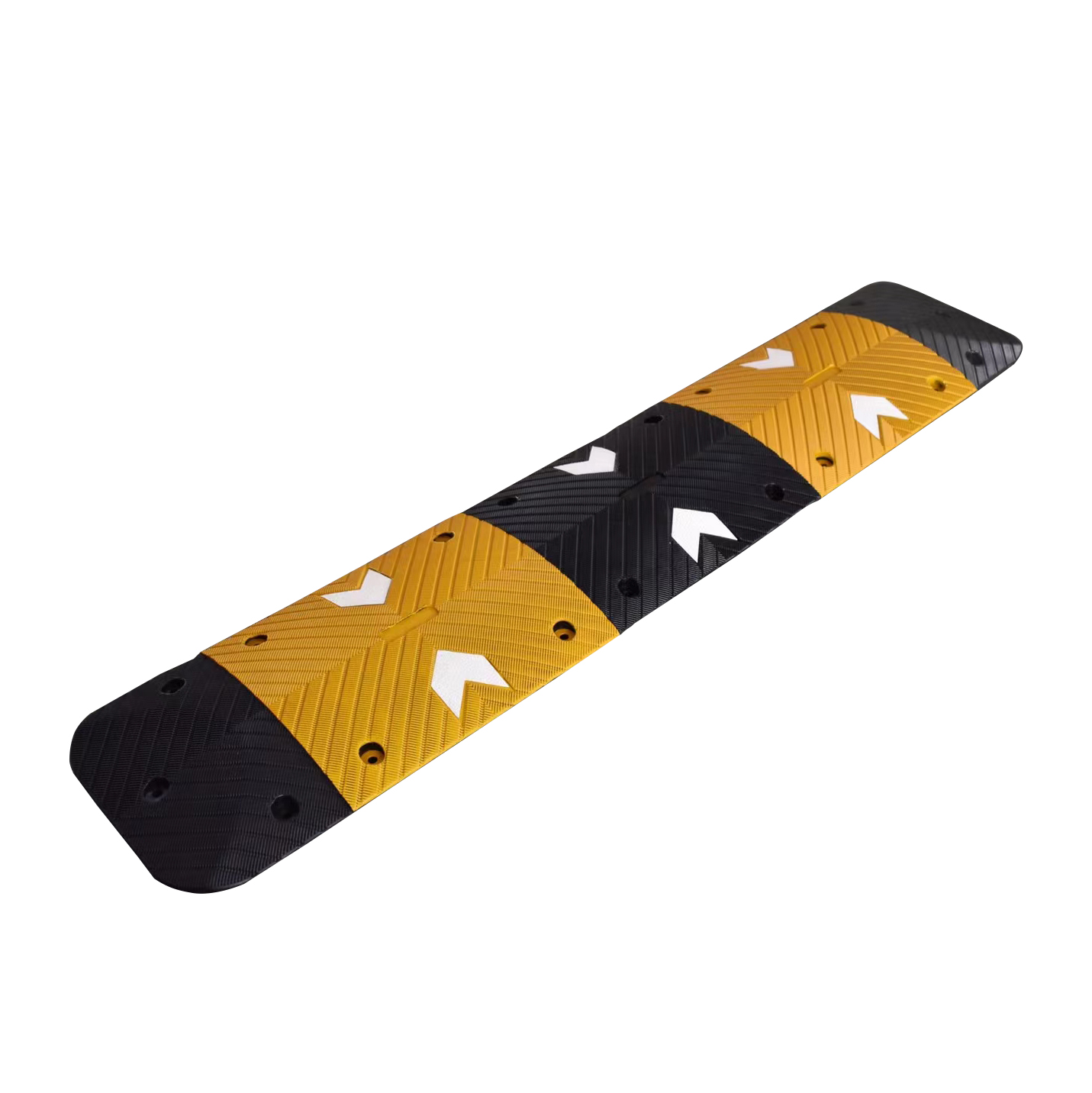
Speed bump S1201. A full-width hump slows every vehicle that crosses it, which is the point and also the problem.
Hump or cushion: that decision comes before the supplier
| Consideration | Speed hump (full width) | Speed cushion (wheel path, with gaps) |
|---|---|---|
| Effect on cars | Slows the tracked width of the vehicle | Slows cars by aligning their wheels to the cushions |
| Effect on buses, fire appliances, large vehicles | Slows them too, with cumulative delay where routes repeat | Designed so wide-track vehicles can straddle or pass outboard |
| Cyclists | Cross the full profile | Can pass through the gap between cushions |
| Drainage | Interrupts the channel, and gully relocation is often needed | Interrupts less, but still affects flow |
| Emergency access | Needs consultation, and may need a bypass arrangement | The common solution where an emergency route has to be preserved |
| Signing and marking | Required on approach | Required on approach, plus markings that make the wheel paths legible |
| Typical car park use | Simple access and aisle control | Where buses, delivery vehicles or emergency access share the route |
Start with the vehicle mix, because that decides the form before any supplier gets involved. If the only traffic is cars and light vans, a full-width hump wins on install cost and on maintenance. Bring buses, fire appliances or regular heavy deliveries onto the same route and that changes, because a cushion layout is normally the only design that delivers the calming effect without blocking access.
What to specify before you request quotes
Send the same list to every supplier. Quotes that come back without answers are not comparable, and that is useful information in itself.
- Vehicle mix. Cars only, or cars plus buses, refuse vehicles, deliveries and emergency access.
- Target operating speed at the hump, and the design speed of the car park.
- Location type. Aisle, entry or exit throat, ramp transition, or an accessible-parking route.
- Proximity to accessible parking. Accessible bays and their access routes carry their own design requirements, separate from the traffic-calming element.
- Drainage. Where the channel runs, and whether any gully falls inside the hump footprint.
- Surface and substrate, whether that is asphalt, concrete, block paving, or a structural deck carrying a waterproofing membrane.
- Fixings. Mechanical anchors into the deck, adhesive, or cast-in. And what each of those does to the waterproofing warranty.
- End treatment. Tapered ends or end caps, and whether they sit inside the unit price.
- Marking and signing. Who supplies them, and to which standard.
- Removability. Whether the hump has to be liftable for resurfacing or for a change of use.
How to compare quotes like-for-like
Four normalisations turn a stack of quotes into a decision.
- Per metre of installed profile, not per unit. Suppliers sell in different module lengths, so a per-unit price hides how many units a given car park actually needs.
- Including or excluding fixings and end caps. This is the most common distortion between quotes. Ask for it as its own line item.
- Including freight and offloading. A heavy modular system arriving on a curtain-sider needs equipment on site that a light system does not.
- Including a labour estimate. A system that installs faster per metre can come out cheaper overall at a higher material price. Ask the supplier for their installation rate per metre, then check it against the contractor's own number.
Then add back the two items that are almost never in the quote: the cost of the drainage adjustment, and the cost of the marking and signing.

Wheel stopper S3108. A different device for the same car park brief, and often specified alongside a hump.
What governs this, by market
The regulatory picture differs by market, and a supplier's documentation often goes quiet at exactly this point. What can be stated from published sources:
Australia. Traffic calming devices on non-arterial roads are addressed in AS 1742.13:2023, which "describes a series of commonly used local area traffic management devices used on non-arterial roads in built-up areas and specifies appropriate signs, delineation and pavement markings". Off-street parking design, which is the car park context itself, sits in AS/NZS 2890.1:2004, and that document "sets out minimum requirements for the design and layout of off-street parking facilities". National guidance on local-street speed management is in the Austroads guide to traffic management, Part 8, which "presents a systematic approach to traffic management in local areas".
New Zealand. Speed management guidance sits in the Traffic control devices manual, Part 6, Speed management, in its Road to Zero edition, together with NZTA's speed management guide of the same edition, which "provides guidance to road controlling authorities on how to establish, consult on and set safe and appropriate speed limits under the Rule".
US and UK. The device geometry requirements sit in the respective national and local instruments rather than in one international standard, and they differ materially, particularly on height, profile and approach marking. Confirm the requirement with the road authority for the specific site before you order. A system acceptable in one jurisdiction is frequently non-compliant in the next one over.
Stated limitation. The detailed geometric values inside AS/NZS 2890.1 and AS 1742.13 sit behind a paywall and are not quoted here, and the equivalent US and UK device dimensions have not been verified for this page. This section therefore says which documents govern, not what dimensions they require. Do not treat a figure on a supplier datasheet as a compliance statement without checking it against the current text of the governing document for that market.
Four things to put to a supplier
- Ask for the module length, and how many modules this car park needs. A supplier who cannot answer has quoted a price rather than a solution.
- Ask for the anchor specification, and what it does to a membrane. On a deck with waterproofing, the answer to this decides whether you end up with a purchase order or a warranty claim.
- Ask how the profile drains. If the answer is that water runs off the sides, ask where the sides discharge to.
- Ask which design vehicle they sized for. A profile sized for cars, then crossed by a refuse truck, gets replaced inside a season.
Where this fits with the rest of the specification
Car park traffic calming is usually one line inside a larger package, and the devices around it carry their own rules. Cones and delineators are the obvious neighbours. Our cone material selection guide covers which material suits which site, and the UK traffic cone standards guide covers the band geometry rules you will also see quoted on hump specifications. If you are comparing suppliers rather than products, the supplier verification guide is the one to read first.

Kerb ramp S1511. Access and egress details are what most car park rejections are actually about.
What the installation actually involves
Cost comparisons tend to stop at the unit price, which is exactly why they mislead. On a car park deck the work breaks into four stages, and each one moves depending on the system.
- Setting out. The position of the first module decides whether the rest of the run lands where the wheels actually go. On a cushion system this matters more, because the gaps have to sit on the tracks vehicles really take rather than the ones on the drawing.
- Anchoring. Into a structural deck, into asphalt, or through a membrane. The last of those is where warranty arguments come from, and it is usually the one the quote does not mention.
- End treatment. Tapered ends or end caps. Whether they sit inside the unit price is the single most common distortion between two quotes for the same job.
- Drainage and marking. Almost always left out of the unit price, and almost always required.
Before comparing totals, ask each supplier for their installation rate per metre. Weight turns out to be a poor predictor of labour. Two systems of the same mass can differ by half a shift a day if one anchors faster than the other, so ask for the rate instead of inferring it from a datasheet.
Common reasons a hump fails at handover
Most rejections are not about the hump itself. They are about what surrounds it, and they usually surface on the day the car park is handed over rather than the day the modules went down.
- Approach markings missing or in the wrong place, so drivers meet the profile with no warning.
- Signs supplied to a different standard from the markings, or left out of the quote on the assumption that the contractor carries them.
- A gully that now sits inside the hump footprint, with ponding that only appears after the first sustained rain.
- Anchors taken through a membrane with no documented detail behind them, which becomes a warranty problem rather than a traffic one.
None of that is expensive to avoid. All of it is expensive to fix once the surface is finished.
FAQ
What actually differs between a cushion and a hump?
The construction differs, and the behaviour follows from it. A hump is continuous across the carriageway, so nothing gets past it without slowing, emergency vehicles included. A cushion keeps the raised profile but breaks it into pads aligned with the wheel paths. Cars are still slowed, because their wheels land on the pads. A bus or a fire appliance runs a wider track, so it straddles the gaps or stays outboard of the pads and holds its speed. The access difference follows directly from that.
Which is better for a car park?
It depends entirely on the vehicle mix. Cars and light vans only, and a full-width hump is simpler and cheaper both to install and to maintain. Add buses, refuse vehicles, regular deliveries or a preserved emergency route, and a cushion layout is normally the design that meets the calming objective and the access requirement together.
How do I compare supplier quotes fairly?
Normalise everything to cost per metre of installed profile rather than cost per unit. Confirm whether fixings and end caps sit inside the price. Add freight and offloading. Then add the two items that are almost always left out, which are the drainage adjustment and the marking and signing.
What standard applies to car park speed humps in Australia?
Two documents carry the Australian requirements. The first, AS 1742.13:2023, covers local area traffic management devices together with the signs, delineation and pavement markings that go with them. The second, AS/NZS 2890.1:2004, covers off-street parking design and the access and egress arrangements around it.
Neither document publishes its geometric values to a public page. Work from the current text rather than from a summary of it, and treat any figure on a datasheet as unverified until you have done that.
Send us the car park layout and the vehicle mix, and we will come back with a module count, the fixing detail and the marking requirement.
Sources
- AS 1742.13, local area traffic management — store.standards.org.au
- Off-street car parking, Australian and New Zealand standard — AS/NZS 2890.1:2004
- Austroads guide to traffic management, Part 8, AGTM08-20 — austroads.gov.au
- NZTA traffic control devices manual, Part 6, speed management — nzta.govt.nz
- NZTA speed management guide, Road to Zero edition — nzta.govt.nz
- MUTCD 11th Edition, for the general principle of device-specific national requirements — mutcd.fhwa.dot.gov
The scope quotations above are reproduced from the cited catalogue pages. Geometric values inside the paywalled standards are deliberately not quoted.
PVC vs PE vs Rubber Traffic Cones: How to Choose for Your Road Works
How to Verify a Traffic Safety Products Supplier in China
Related Article